Key takeaways
- Online Quran classes can be a safe, convenient way for children to learn, and safety depends on the academy's practices and on simple habits at home.
- Ask any academy how it chooses teachers, how lessons are run and how parents can raise a concern.
- Keep lessons in a shared space, stay nearby and keep all communication with the teacher through you.
- Know the warning signs, and act on them straight away: stop the lessons, tell the academy and report to the appropriate authority.
Online lessons let children learn the Quran from home, with a teacher they might never find nearby. Most families have good experiences. But any time a child is in a one-to-one video call with an adult, a thoughtful parent asks how to keep things safe.
This guide is not meant to frighten you. It is meant to give you a clear, practical set of questions to ask and habits to keep, so that you can enjoy the benefits of online learning with confidence.
The short answer
Online Quran classes can be safe. The safety comes from two places: how the academy operates, and how you set up lessons at home. Neither is hard, and both are worth doing before the first class.
What to ask an academy before you enroll
A good academy will answer these questions clearly and without discomfort. Hesitation is useful information.
- How do you choose and check your teachers? Ask about interviews, references and any background checks that are appropriate in the teacher's country.
- How are lessons conducted? Which platform is used, and are lessons live?
- Can I be present or nearby, and can I observe the trial lesson?
- Are lessons recorded, and who can access the recordings? At Quran Mentor, all plans include access to recordings.
- How do I raise a concern, and who will respond?
- Can I change my child's teacher at any time? (At Quran Mentor, yes.)
- Who contacts the child? The answer should be that all communication goes through you, the parent.
- Is a female teacher available? Many families prefer this for daughters and for younger children. At Quran Mentor, female teachers are available.
If an academy cannot explain how it works, or avoids questions about teacher selection and communication, choose a different one.
How to set up lessons at home
Small habits make a big difference.
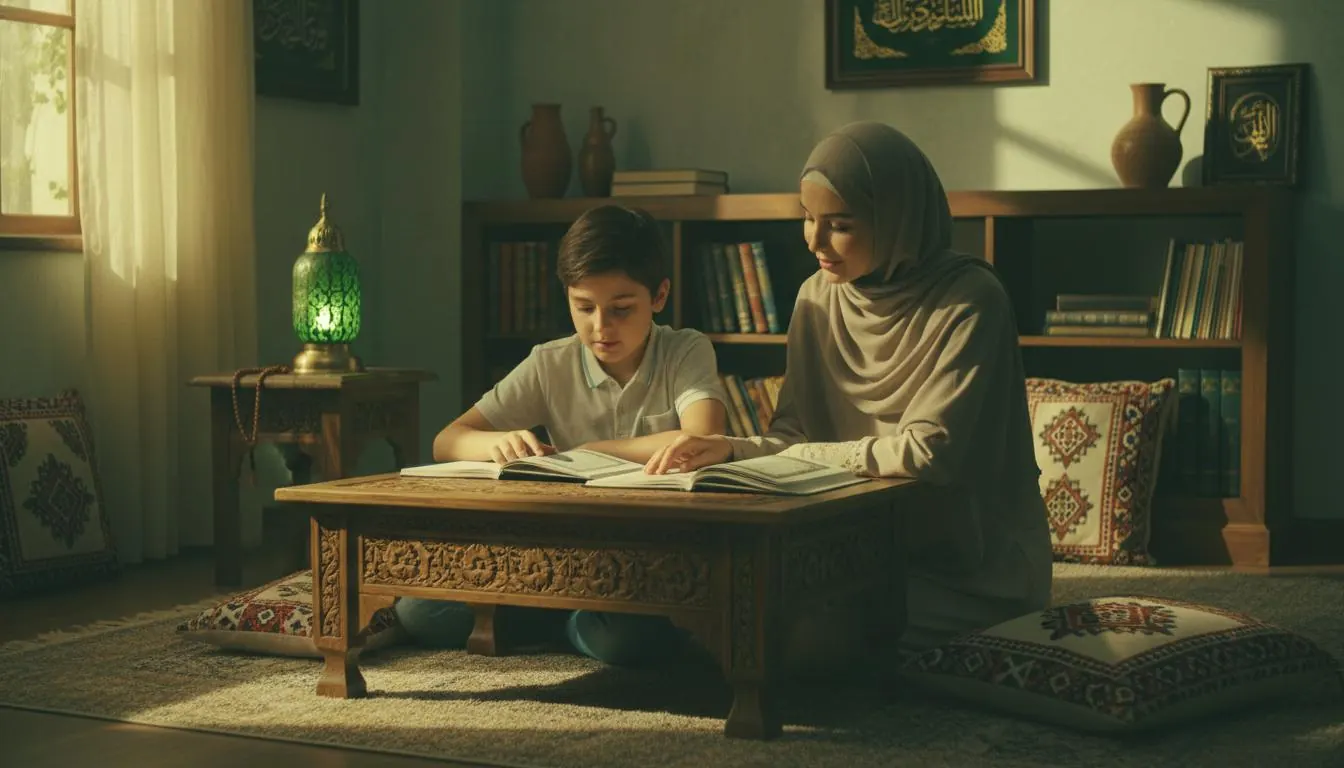
- Use a shared space. Have your child take lessons in the living room or another open area of the house, not in a bedroom with the door closed.
- Stay close. For younger children especially, be in the room or within earshot, at least in the first weeks. Older children can have a little more independence, but you should still be nearby.
- Keep the camera and microphone for lessons only. Make sure the device is used for the lesson and not left on afterward.
- Share only parent contact details. Your child should not exchange personal contact details, social media accounts or private messages with the teacher.
- Use the academy's platform. Lessons and communication should stay on the platform the academy uses. Be cautious if a teacher asks to move to a different app.
- Know the lesson time. Your child should attend at the times you agreed, with you aware of the schedule.
Teach your child a few simple rules
Children are safest when they know what is normal and what is not, and know that they can always tell you.
- Lessons are about the Quran and nothing else.
- A teacher should never ask you to keep a secret from your parents.
- If anything a teacher says or does makes you feel uncomfortable, you can stop the lesson and tell me, and you will never be in trouble for telling.
- Your body, your photos and your private information are yours.
Say this calmly and repeat it from time to time, as part of normal conversations about staying safe online and offline.
Warning signs to take seriously
Act if you notice any of these:
- The teacher asks for your child's personal number, social media or private messages.
- The teacher asks your child to keep something secret, or asks you to leave the room.
- The teacher gives gifts or attention that seems out of proportion.
- The teacher talks about personal or inappropriate topics, or comments on your child's appearance.
- The teacher pressures your child to take lessons outside the agreed schedule.
- Your child suddenly dreads lessons, becomes withdrawn or does not want to say what happened.
One sign does not always mean the worst, but you should never ignore it.
What to do if something worries you
- Stop the lessons while you look into it. You do not need proof to pause.
- Stay calm and talk to your child in a supportive way. Listen, and do not blame them.
- Tell the academy in writing and ask for a response.
- Report it. If you believe a child has been harmed or is at risk, contact the appropriate authority. For example, in the USA you can use the National Center for Missing & Exploited Children's CyberTipline, in Canada Cybertip.ca, and in the UK the NSPCC helpline or the police. In other countries, contact local child protection services or the police. If a child is in immediate danger, call your emergency number.
What online learning does well for safety
Online lessons also have some safety strengths. You can see and hear the lesson from the next room, your child is at home instead of traveling, and recordings (where available) make it possible to review a lesson. The key is to use these strengths on purpose.
How we approach it at Quran Mentor
We teach one-to-one on Zoom, so your child learns from home and you can stay nearby. Female teachers are available. You can request a different teacher at any time, and all plans include access to recordings. Your free trial lets you meet the teacher and watch how a lesson works before you decide. If you have questions about how we work, please ask us before you book.
Frequently asked questions
Are online Quran classes safe for young children?
They can be, with the right academy and good habits at home. For young children, being nearby during lessons is a sensible rule.
Should a parent sit in on the lesson?
For the first lessons, yes, especially for younger children. It also helps you understand what your child is learning and how the teacher works. Many parents then stay close but let the child focus.
Is a female teacher safer for girls?
Gender alone does not guarantee safety, and the same habits apply to every lesson. But many families feel more comfortable with a female teacher for their daughters, and that preference is reasonable.
Can I have my child's lessons recorded?
Ask your academy. Recording policies differ, and you should know who can access any recordings. At Quran Mentor, all plans include access to recordings.
How do I choose a good academy overall?
Use our parent's checklist for choosing an online Quran teacher, and look at our Quran classes for kids.