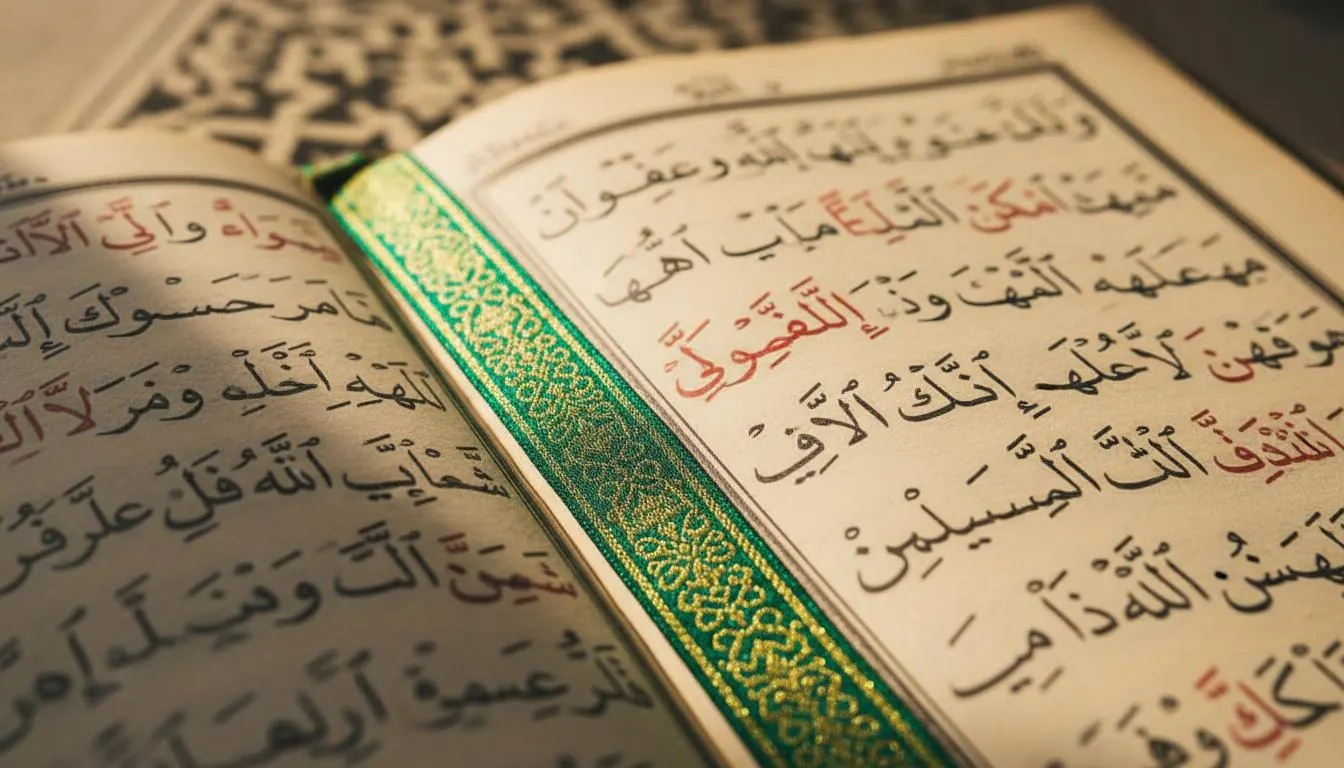
Key takeaways
- Tajweed is the set of rules for reciting the Quran accurately, including where letters come from and how long to hold sounds.
- You do not need to know Arabic to learn it, but you do need to read the script comfortably first.
- Start with letter sounds (makharij), then the noon and meem rules, madd (lengthening), qalqalah and stopping.
- Because you cannot hear your own mistakes, correction from a qualified teacher is the fastest way to improve.
Many people learn to read the Arabic letters and then wonder what comes next. Often the answer is Tajweed. It is the part of learning the Quran that turns "I can read the words" into "I can recite them correctly."
This guide explains what Tajweed is, why it matters and which rules to learn first, in plain English. It is an introduction. A qualified teacher should guide you through the details and correct your recitation.
What is Tajweed?
Tajweed comes from an Arabic word meaning to make something excellent or to do it well. In the context of the Quran, it is the science of reciting each letter from its correct place in the mouth and throat, with its correct qualities, and applying the rules that affect how letters are pronounced next to each other.
Surah Al-Muzzammil (73:4) instructs recitation of the Quran in a measured, deliberate way. Learning Tajweed is how many Muslims put that into practice.
Why Tajweed matters
- Accuracy. Arabic has sounds that are close to each other. Saying the wrong one can change a word.
- Preserving the recitation as it was taught. Tajweed is passed from teacher to student, and learning it connects you to that chain.
- Beauty and confidence. Reciting correctly makes recitation smoother and more beautiful, and many learners find it makes them more confident in prayer.
Scholars have written extensively about how obligatory the different parts of Tajweed are. There is wide agreement that Muslims should avoid clear mistakes that change the meaning and should strive to recite correctly. For a ruling that applies to you, please ask a qualified scholar or your teacher.
Before you start: can you read Arabic?
You do not need to understand Arabic, but you do need to read the script comfortably. If you are still learning the letters, start with Noorani Qaida and move on to fluent reading. Our Tajweed course is designed for students who can already read the script.
The first rules to learn
1. Makharij: where each letter comes from
Makharij (singular makhraj) are the points of articulation: the throat, tongue, lips and nasal passage. Every Arabic letter comes from a particular point. Learning where a letter comes from is the foundation, because the other rules rest on it.
2. Sifaat: the qualities of letters
Sifaat are the characteristics of each letter, such as whether it is pronounced with a full, heavy sound (tafkheem) or a light one (tarqeeq). Two letters can come from the same place but differ in their qualities.
3. Noon sakinah and tanween
When a noon with no vowel (نْ) or tanween (the double vowel marks) is followed by a letter, there are four possible treatments, depending on the letter that follows:
| Rule | What it means | When it applies |
|---|---|---|
| Izhar | Pronounce the noon clearly | Before the six throat letters (ء ه ع ح غ خ) |
| Idgham | Merge the noon into the next letter | Before the letters ي ر م ل و ن |
| Iqlab | Change the noon into a hidden meem sound | Before ب |
| Ikhfa | Hide the noon, with a light nasal sound | Before the remaining letters |
4. Meem sakinah
A meem with no vowel (مْ) has three treatments: hiding it before ب (ikhfa shafawi), merging it into another meem (idgham shafawi) and pronouncing it clearly before other letters (izhar shafawi).
5. Ghunnah
Ghunnah is a nasal sound that comes from the nose, held for a short count. It appears with a noon or meem that carries a shaddah (the doubling mark) and in several noon and meem rules.
6. Madd: lengthening
Madd means stretching a vowel sound. The natural madd is held for two counts. Other kinds of madd are longer and depend on the letters that follow. The exact counts and details depend on the recitation your teacher teaches, so learn them with a teacher.
7. Qalqalah
Qalqalah is a slight echoing or bouncing sound on five letters when they have no vowel: ق ط ب ج د. It helps those letters stay clear and distinct.
8. Stopping and starting
Where you stop for breath and how you stop affects both meaning and sound. Learn the stopping signs in the mushaf and how to pause correctly at the end of a word.
Common mistakes English speakers make
- Mixing up letters that have no English equivalent. The throat letters ع and ح, the deep letter ق and the heavy letters ص ض ط ظ are common trouble spots.
- Confusing similar sounds. Learners often blur pairs such as ث ذ ظ, س ص, ت ط and د ض.
- Shortening long vowels. English speakers tend to cut sounds short. Madd needs patience.
- Adding extra vowels. Putting an "uh" sound after a letter that should have no vowel.
- Skipping the nasal sound. Missing ghunnah is very common.
- Rushing. Reading fast hides mistakes. Slow, accurate recitation is the goal.
How to practice
- Listen first. Listen to a skilled reciter slowly reciting a short passage, and repeat it.
- Start small. Short surahs and Al-Fatiha are a good place to apply what you learn.
- Practice little and often. Ten to fifteen focused minutes a day is more effective than one long session.
- Record yourself. Listening to your own recording shows you things you cannot hear while reciting.
- Get live correction. This is the key step. You cannot hear your own mistakes, so a teacher who listens and corrects you in real time saves you from repeating errors.
How long does it take?
It depends on your starting point, your practice and your teacher. Learning the basics takes months, and good recitation keeps improving for years. See our guide on how long it takes to learn to read the Quran for a staged overview.
Frequently asked questions
Do I need to know Arabic to learn Tajweed?
No. You need to be able to read the Arabic script, but you do not need to understand the language to learn the rules of recitation.
Is Tajweed obligatory?
Scholars discuss this in detail. There is wide agreement that Muslims should avoid mistakes that change the meaning and should try to recite correctly. For a specific ruling, ask a qualified scholar.
Can I learn Tajweed from apps or videos?
They are helpful for listening and review. But they cannot hear you or correct your pronunciation, which is why most learners combine them with live lessons.
How is Tajweed different from just reading well?
Fluent reading means decoding the words smoothly. Tajweed adds the rules for the correct sounds, lengths and pauses.
What does Quran Mentor's Tajweed course cover?
It covers Makharij (articulation), Sifaat (characteristics), Noon and Meem rules and Madd rules. It is listed as a 12-week course and taught one-to-one. See the Tajweed course for details.